
Car Wash Facility Roofing in Greensboro, NC
Roofing for Greensboro car wash tunnels and express sites; vapor-managed assemblies and chemical-resistant PVC that survive the humidity and soaps a wash throws at the deck.
Request A Roof Walk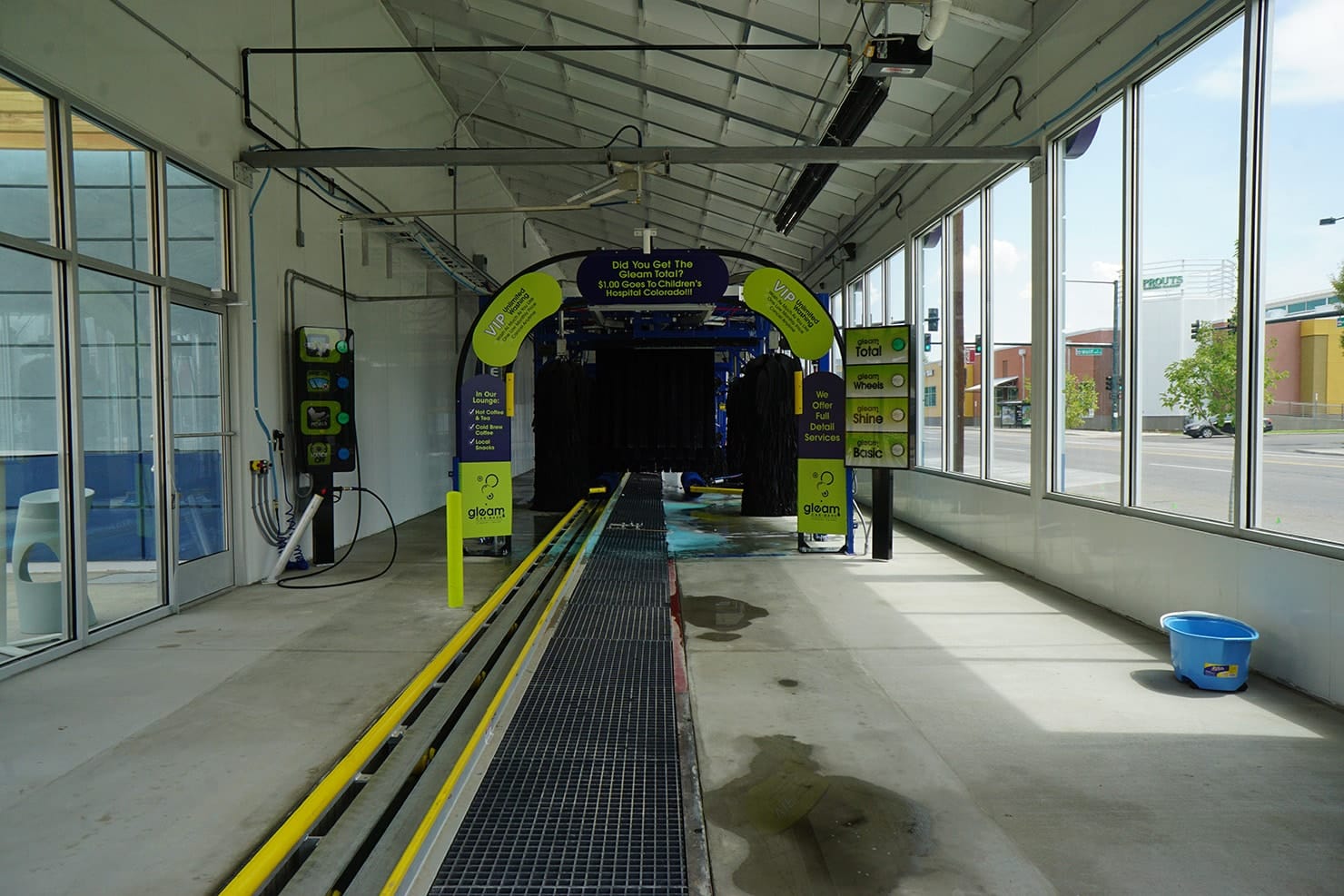
The car wash boom along West Wendover Avenue, Battleground Avenue, and the High Point Road corridor has put express tunnels and in-bay sites on some of the busiest retail pads in Guilford County. We roof those buildings, and we approach them differently than a strip center or an office pad because a car wash punishes a roof from the inside out. Owners near Friendly Center, the Adams Farm shopping nodes, and the newer pads off Bryan Boulevard call us when the standard membrane a general contractor installed starts failing years early, and the cause is almost always the same: nobody designed the roof for the building underneath it.
Why a Car Wash Roof Fails From Below
A car wash runs warm, saturated air twenty-some feet up against the deck for most of the day. The steam off a hot-water arch carries detergent, presoak, drying agents, and rust-inhibitor mist with it, and that vapor condenses on the underside of the roof deck and on the heads of the fasteners holding the system down. On a metal deck, that means corrosion you cannot see from the roof surface until a fastener pulls through. On a wood deck, it means rot starting at the panel seams. We have opened up tunnel roofs in Greensboro where the membrane on top looked serviceable and the deck beneath it had lost most of its bearing capacity to vapor-driven corrosion.
This is the part that gets missed. Most roofers inspect the top of the roof. On a wash building, the failure starts at the underside and works up, so our inspection includes the deck condition from inside the equipment mezzanine and tunnel ceiling wherever access allows. If the deck is compromised, replacing the membrane alone is throwing money at a symptom.
Vapor Drive and the Insulation Sandwich
The fix is a roof assembly that manages vapor instead of trapping it. Above the wash tunnel and the equipment room, we look at a vapor retarder over the deck, then insulation, then membrane, so warm interior moisture is stopped before it reaches the cold layers where it would condense. Get the layer order wrong and you build a sponge between the deck and the membrane. We size that assembly around the actual interior conditions of the tunnel, not a generic commercial spec, because a self-serve bay that sits open to the air behaves nothing like a sealed express tunnel running a full chemical menu.
Membrane Selection for Chemical Exposure
The chemistry matters at the surface too. Drying agents and wax compounds get pulled out of the tunnel by the exhaust fans and land back on the membrane and the edge metal around the exhaust shrouds. Many single-ply warranties carry exclusions for exactly this kind of chemical contact. PVC holds up to the alkaline soaps and the petroleum-based dressings better than most alternatives, which is why we lean toward a reinforced PVC over the tunnel and equipment areas. Before we commit, we ask the operator what they actually run through the arches, then we match that against the membrane manufacturer's chemical-resistance data so the warranty is real and not a sheet of paper with a carve-out that voids it the day the wash opens.
The Exhaust and Equipment Penetrations
A wash building is dense with rooftop penetrations: tunnel exhaust shrouds, reclaim-system vents, the make-up air units, and conduit for the point-of-sale canopy. Each one is a path for water and each one sees more heat and chemical load than a normal curb. We flash these as individual details with oversized, chemical-tolerant boots and counterflashing, not with a one-size pitch pocket. The goal is that the weakest point on the roof is still stronger than what the wash cycle throws at it.
Vacuum Canopies and Pay Stations
The exterior structures are their own scope. The vacuum-station canopies and the pay-lane covers take vehicle exhaust, tire-shine overspray, and full sun, and the transitions where those canopies tie back to the main building are the spot we find chronic leaks on Greensboro express sites. We re-flash those tie-ins, address the canopy gutters and internal drains, and keep that work on a separate maintenance rhythm from the main roof because the failure modes are different.
Working Around a Wash That Stays Open
Tunnels in this market run seven days a week through most of the year, and an idle wash is lost revenue. We sequence tunnel roof work into the early-morning window before opening or the late-close window, keep each section dried in before we leave it, and run the exterior canopy and equipment-room work during operating hours with the lanes coned off so cars keep moving. We schedule around the wash; we do not ask the wash to schedule around us.
On a wash building the damage usually starts underneath. Warm, chemical-laden vapor from the tunnel condenses on the deck and fastener heads and corrodes them from below, so the deck can be failing while the membrane on top still looks intact. We inspect the underside of the deck from inside the building wherever we can reach it, because a top-only inspection misses the real problem on a Greensboro car wash.
We favor a reinforced PVC over the tunnel and equipment areas because it resists the alkaline soaps, drying agents, and wax compounds far better than the standard membranes a general contractor typically installs. We confirm the choice against the specific chemicals your wash runs and the manufacturer's chemical-resistance data so the warranty actually covers your operating conditions.
Yes. The roof assembly over a tunnel has to manage vapor drive, which usually means a vapor retarder at the deck and an insulation layup sized to the interior humidity. Get the layer order wrong and moisture condenses inside the assembly and rots it out. We design that buildup around your actual tunnel conditions rather than a generic commercial spec.
In almost every case, yes. We run tunnel work in the pre-open or post-close window and keep each section watertight overnight, then handle the canopy and equipment-room work during business hours with the affected lanes coned off. The wash keeps running.
Yes. The vacuum and pay-lane canopies, their gutters and drains, and the points where they tie into the main building are all part of the scope. Those tie-ins are the most common chronic leak on Greensboro express sites, so we re-flash and detail them along with the main roof.